
ADA Restroom Costs for Indoor Playgrounds (And How the Right Building Could Save You $30,000)


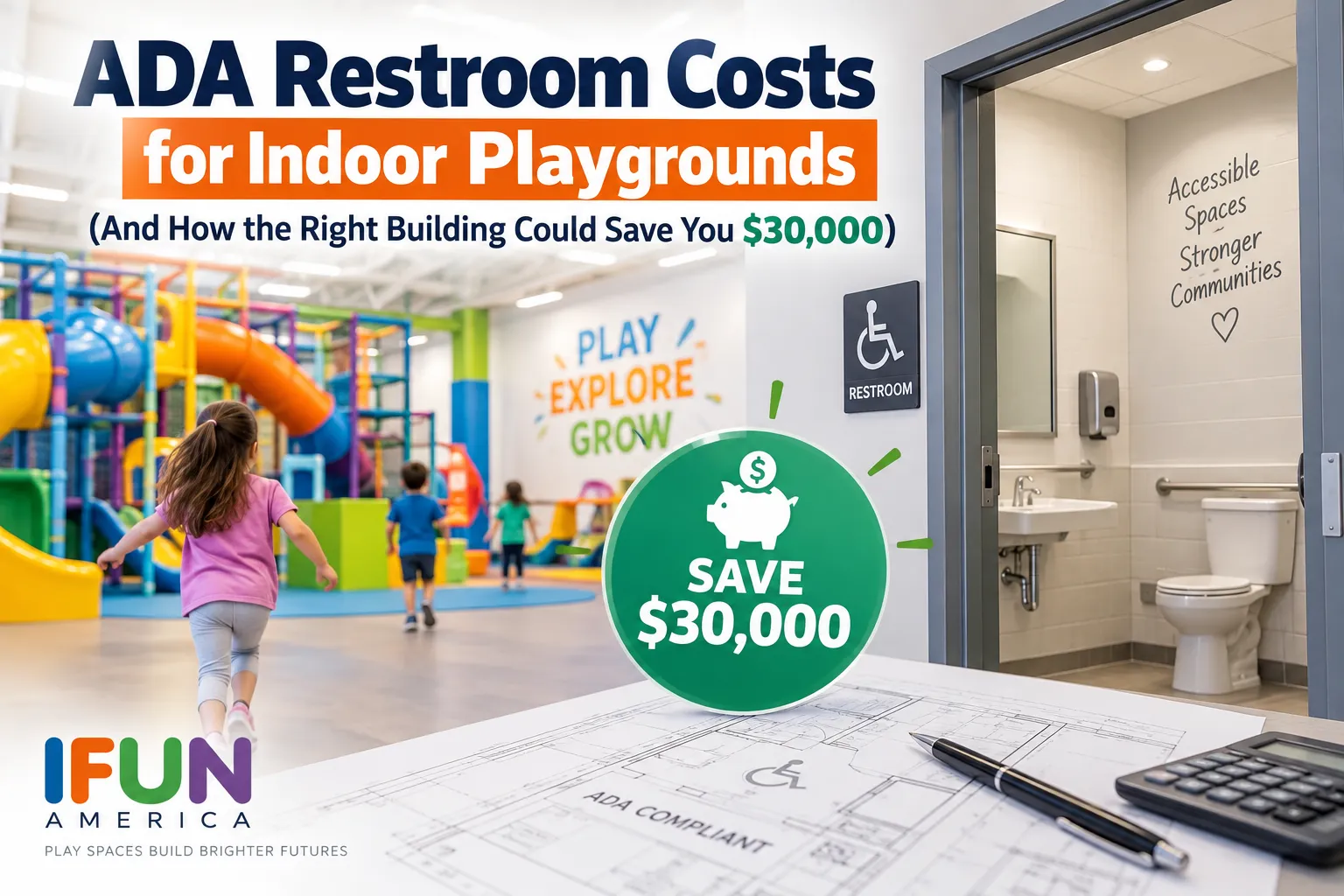
Let's state the obvious: Restrooms are an unglamorous topic. They rarely make it into anyone's mental picture of "opening a play café". However, the truth is, they're one of the first places a great location choice can save you a five-figure sum- we're serious! Unlike your play structure, where design choices genuinely change your outcome, restroom cost is driven almost entirely by one factor: whether the building already has one where you need it.
What it costs to build from scratch
Building a single ADA-accessible stall with a sink from scratch runs around $30,000. That number covers the plumbing, the fixtures, the accessible clearances, and the finish work required to pass inspection- not a simple cosmetic build.
Once the plumbing is already run, adding capacity gets meaningfully cheaper:
Item
Cost
Cosmetic updates only (existing usable restroom)
~$3,000
First ADA stall + sink, from scratch
~$30,000
Second stall (plumbing already run)
~$20,000
Each additional stall after that
~$10,000
That drop-off after the first stall is the key detail: the expensive part isn't the fixture, it's running the plumbing in the first place. Once that's done, capacity is comparatively cheap to add.
Why this is a leasing decision, not a construction one
If the building you're touring already has a usable restroom where you need it, your cost drops to cosmetic updates which is usually a few thousand dollars, not thirty thousand. That's the entire lesson of this phase: the easiest $30,000 you'll ever avoid spending is picking a space that already has a bathroom where you need it.
This is worth internalizing before you fall in love with a space for other reasons. A great location for a play cafe with beautiful bones and no usable restroom can quietly cost as much as a mediocre location with one already in place.
A few things to keep in mind as you evaluate spaces:
Occupancy code may dictate a minimum number of fixtures for your square footage and use, regardless of what you'd prefer to build. Confirm the requirement for your specific occupancy count before you finalize a design. This ties directly back to the HVAC occupancy math covered earlier in this series, since both are driven by the same underlying occupancy rating.
"Has a bathroom" isn't the same as "has a bathroom where it works." A restroom that exists but sits in the wrong corner of the building relative to your floor plan can still cost real money to relocate. You can shift a fixture a little without re-triggering major cost, but moving plumbing across the building re-triggers the expensive work, essentially starting the $30,000 line item over.
If you need a second stall, confirm the existing plumbing can actually be tapped rather than re-run from scratch. That confirmation is the difference between a $5,000–$20,000 add and another $30,000 build.
What to check during a walkthrough
Before you get attached to any space, walk it specifically looking for this:
- Find the existing restrooms before you evaluate anything else about the layout. Note how many fixtures there are and whether their location actually works with the floor plan you're picturing.
- If the space needs an additional restroom to meet code, make that build-out an explicit tenant-improvement line item in your lease negotiation, rather than assuming it's yours to absorb. It's a building-level upgrade that outlasts your tenancy and exactly the kind of cost landlords are most willing to fund, as covered in the lease negotiation post earlier in this series.
What can go wrong
- Assuming an existing restroom "counts" without checking its location relative to your floor plan can turn a cosmetic update into a full relocation cost.
- Not confirming occupancy-driven fixture minimums before finalizing a design can mean a code-required change after you've already committed to a layout.
- Treating restroom cost as a construction line item instead of a leasing filter means missing the easiest savings opportunity in this entire phase; one that's decided the moment you sign, not the moment you build.
-
The takeaway
Restrooms don't offer the same design flexibility that equipment or theming do. There's no clever workaround that makes a $30,000 build cheaper once you're committed to a space without one. The entire savings opportunity happens earlier, during your walkthrough, by choosing a building that's already done this work for you.
This is just one phase of the full build. Get the complete phase-by-phase cost breakdown (restrooms, kitchen, party rooms, shell, and everything between signing and grand opening) in one guide!


More recent Articles
Let's Chat
Reach out anytime by phone, email, or form. We're eager to get started on your next project.