
Indoor Playground Equipment Cost Per Square Foot: What Actually Drives the Price


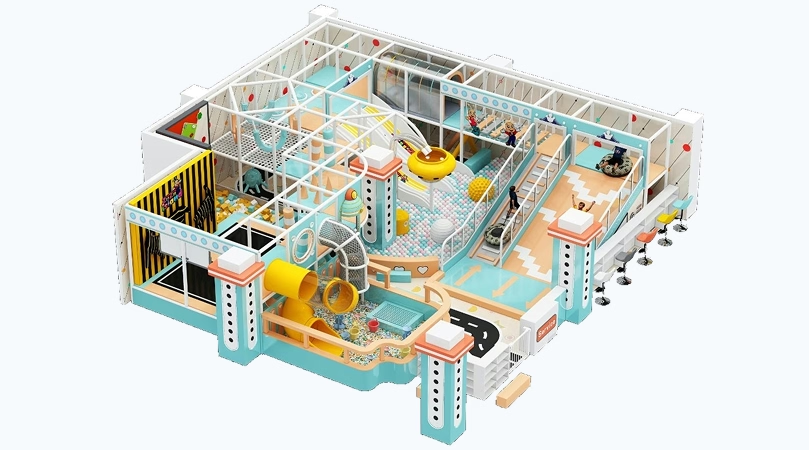
By this point in the series, you've worked through feasibility, your lease, and the HVAC surprise that catches so many first-time owners off guard. Now we get to the phase most owners think about first, even though it isn't where the budget actually gets decided: the play structure itself.
This is the heart of your business and its primary draw; it's also your single largest controllable cost. Unlike a lease clause or an HVAC gap that's largely dictated by the building you picked, equipment is a line item you shape directly, with real range depending on the decisions you make.
The baseline: $35–$100 per square foot of play area
Indoor playground equipment typically runs $35 to $100 per square foot of the designated play area — not the whole building. That distinction matters, because your play area is usually only a portion of your total footprint.
A useful planning rule: the play area is typically about 55% of your total square footage, with the rest going to seating, kitchen, restrooms, front desk, back office, and circulation space. So a 5,000-square-foot medium facility might have roughly 2,750 square feet of actual play area. That's the number to run your per-square-foot math against, not the full lease footprint.
Here's what that looks like across the size classes covered earlier in this series:
Size class
Equipment budget range
Small (up to 3,000 sq ft total)
~$38K
Medium (3,000–7,000 sq ft total)
~$100K
Large (7,000+ sq ft total)
~$225K
Those figures are directional planning numbers, not quotes. Your actual cost depends heavily on design, size, and feature choices, which brings us to what actually moves a project up or down within that $35–$100/sq ft range.
What pushes a project toward the high end
A fully custom 2D/3D design. Equipment designed specifically for your floor plan- accounting for your columns, your ceiling height, and your entrances - maximizes play-per-square-foot instead of forcing your space to accommodate an off-the-shelf layout. Custom design costs more upfront, but it also avoids paying for wasted space and prevents costly field modifications during installation when an off-the-shelf set doesn't quite fit.
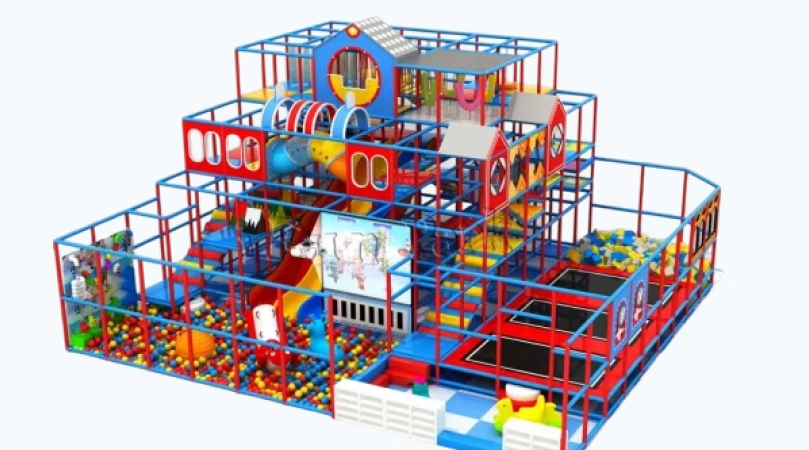
Attraction mix and variety. A single-story soft play structure sits at a very different price point than a multi-level structure combined with trampolines, an arcade, and a mini town concept. Each additional attraction type adds both equipment cost and design complexity.
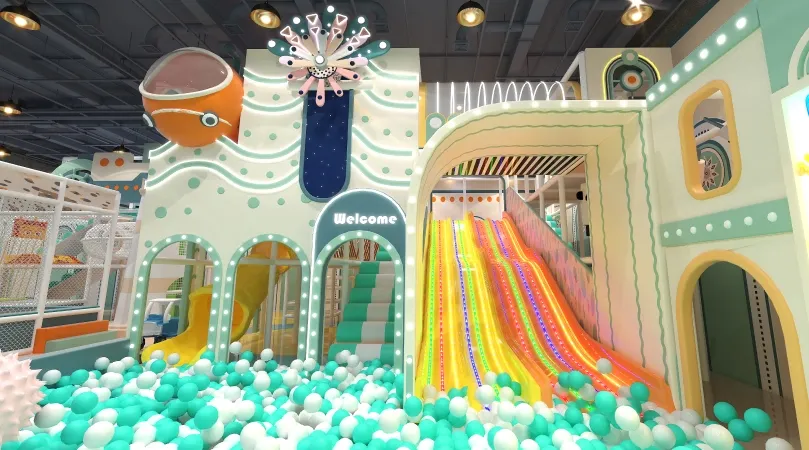
Theming and finish level. Immersive, fully themed builds cost meaningfully more than a clean, colorful structure with simpler finishes. Both can be excellent business decisions. The right call depends on your market and your brand, not on which one is "correct."
Height and structure complexity. Multi-level structures with taller vertical elements require more engineering, more steel, and more installation labor than a single-story layout in the same footprint.
What keeps a project toward the low end without cutting corners
Right-sizing your attraction mix to your actual market, rather than trying to fit every attraction type into your opening budget. Many successful facilities open lean and add attractions later once revenue is proven.
A custom design that's still efficient, prioritizing play-per-square-foot over maximum theming. Custom doesn't have to mean expensive. It means the equipment is designed to make the most of the space you're actually paying rent on.
Sourcing decisions, which matter enough that they get their own post next week :-). Bottom line is that going factory-direct rather than through a domestic reseller can meaningfully change your per-square-foot number without changing your design at all.
See what's actually driving these numbers
The equipment types referenced throughout this post (multi-level indoor playground structures, trampolines, soft play, and themed concepts like mini towns) are worth browsing directly rather than imagining in the abstract:
• Indoor Playground Structures - the core multi-level attraction most medium and large facilities are built around
• Trampoline Equipment- a strong add-on or standalone concept, depending on your market
• Soft Play - the right starting point for smaller spaces and younger age groups
• Mini Town- role-play attractions that work well as a differentiator in a competitive market.
Seeing the actual equipment side by side with these numbers makes it much easier to picture where your own project is likely to land in the range.
What can go wrong
• Pricing off a whole-building number instead of play-area square footage leads to a budget that's either wildly overestimated or, more dangerously, underestimated once the real design comes together.
• Scope creep during design; such as, adding "just one more" attraction type, can move a project from the low end of its size class to the high end without anyone deciding that deliberately.
• Skipping a custom design in favor of an off-the-shelf layout can actually cost more in the long run, through wasted floor space and field-modification costs during installation.
The Takeaway
Your play structure is where the biggest single decision in your build happens and it's one of the few places where a smart choice, rather than a lucky building, is what determines your final number. Next, we'll cover the sourcing decision that has the single biggest impact on where you land in that $35–$100/sq ft range: buying factory-direct playgrounds versus going through a reseller.
Want a real number instead of a range? Get a free custom 2D/3D concept render for your actual space, sized and priced for your exact footprint.
Get a Free Custom Quote · Browse Equipment



More recent Articles
Let's Chat
Reach out anytime by phone, email, or form. We're eager to get started on your next project.